Program Overview
The University of North Alabama’s four-year Bachelor of Engineering (B. Eng.) program is designed to provide our students with a strong foundation in core engineering topics while allowing the flexibility to develop competencies in more than one field.
Designed with input from our regional industrial partners, our curriculum emphasizes the knowledge, skills, and qualities that companies want every engineer to have while allowing students to tailor their courses to best suit their career ambitions.
Why Choose This Program?
The B.Eng. program is designed with the engineering needs of regional industries as a primary focus; however, graduates of this program will also be well prepared for graduate school, professional schools (e.g., law or medicine), or an entrepreneurial career through selection of an appropriate combination of engineering certificates. Individual certificates can be earned in the following specialization areas:
- Biological Engineering: A captivating branch of engineering that combines engineering principles with biological processes with the goal of creating beneficial products
- Chemical Engineering: A multifaceted discipline primarily involving the design of processes necessary to produce, alter, and transport various chemicals
- Engineering Management: A specialized interdisciplinary that applies engineering techniques to business systems and processes used to bring solutions from idea to implementation
- Manufacturing Engineering: Concerned with the development, operation, and improvement of tools, processes, integration facilities, and systems that ensure the efficient and safe manufacture of quality products
- Power Generation Engineering: Centered on the planning, creation, and improvement of energy-producing systems to produce electricity effectively and sustainably
Curriculum & Coursework
UNA’s engineering curriculum combines a strong foundation in math, science, and core engineering principles with hands-on, project-based learning. As you progress, you’ll apply what you’re learning through labs, design projects, and real-world problem solving—building both technical expertise and practical experience. The program is designed to help you think critically, collaborate effectively, and graduate prepared to step confidently into a wide range of engineering careers.
Sample Courses:
- EG 120 Engineering Problem Solving
- EG 302 Engineering Economics
- EG 305 Engineering Thermodynamics
Career Paths & Outcomes
Whether you’re interested in developing sustainable solutions, designing and improving manufacturing systems, working in fields like energy, healthcare, or technology, or even pursuing graduate or professional school, UNA’s engineering program prepares you to apply your skills in meaningful, practical ways. With the flexibility to explore different concentrations, you can shape your path toward a career that fits your interests and goals.
Common Career Paths:
- Environment Mitigation
- Food Production
- Renewable Energy
- Manufacturing
- Pharmaceutical Industry
Student Experience
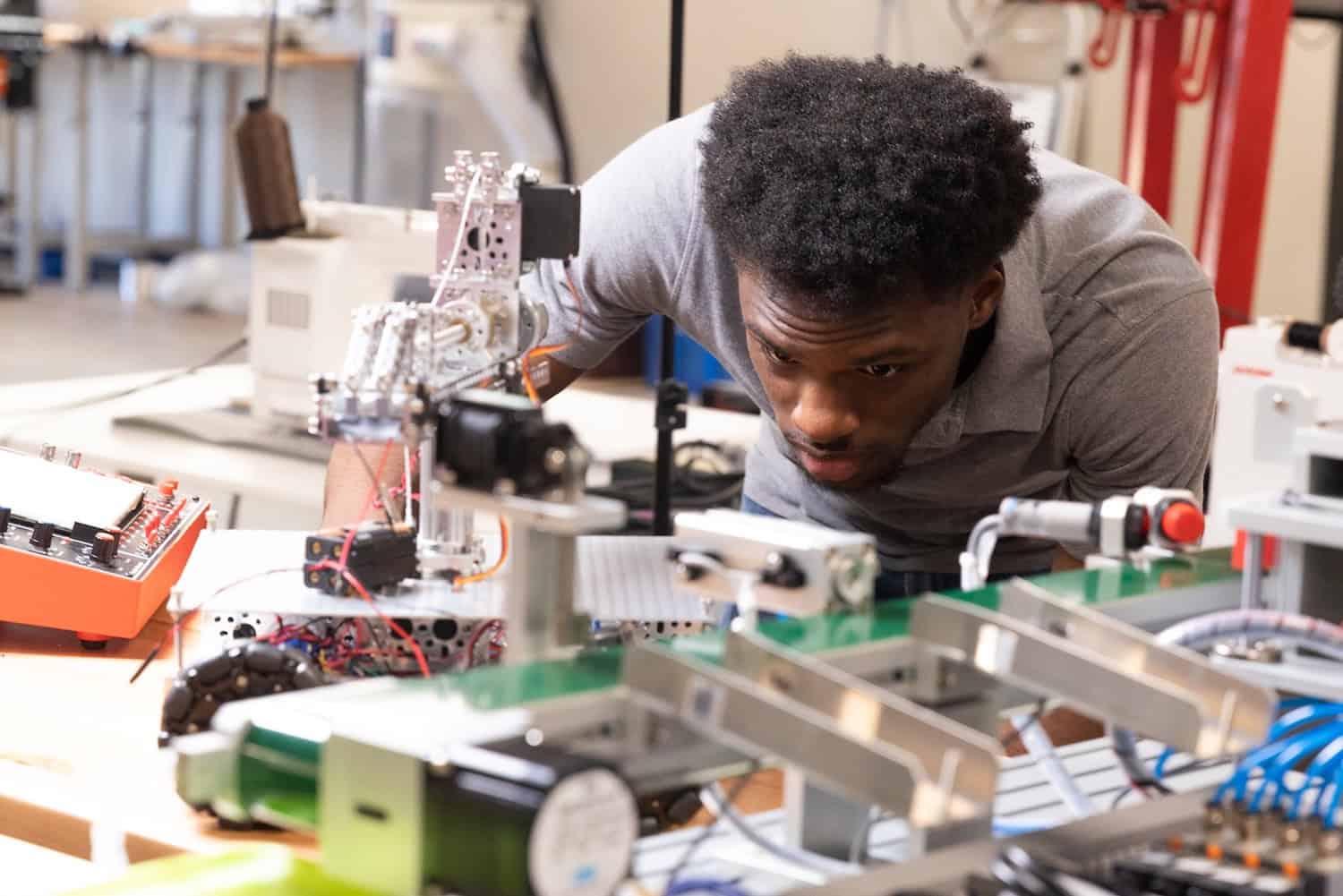
The Engineering and Industrial Professions department offers students access to state-of-the-art laboratories that provide immersive, hands-on learning experiences across various engineering disciplines. The Lowell M. and Judith Carolyn Guthrie Mechanical Engineering Lab features advanced CNC equipment, 3D printers, and materials testing systems for manufacturing, design, and structural analysis courses. Students in the Electrical Engineering Lab gain valuable experience in circuit design, robotics, and green energy through access to oscilloscopes, PLC trainers, solar and wind energy trainers, and Arduino kits. These facilities support core coursework and foster essential skills in automation, controls, and sustainable energy systems.
Opportunities include:
- Mechanical Engineering Lab – CNC equipment, 3D printers, materials testing systems
- Electrical Engineering Lab – oscilloscopes, PLC trainers, solar and wind energy trainers, and Arduino kits
- Student clubs related to the major
- Service learning or volunteer experiences
- Study abroad or global learning
- Conferences, competitions, exhibitions, etc
[UNA: Please confirm opportunities]
Meet the Faculty
Dr. Wael Al Kouz
Associate Professor, GZU Lab Coordinator
walkouz@una.edu
Dr. Nagi A. Muftah Buaossa
Assistant Professor, GZU Engineering Technology Assessment Coordinator
nbuaossa@una.edu
Dr. Michael B. Collins
Assistant Professor, OEHS
mcollins2@una.edu
Dr. Douglas E. DeMoulin
Assistant Professor, GZU-OHS
Dr. Bankole Fasanya
Assistant Professor, GZU OHS
bfasanya@una.edu
Dr. Yang Geng
Assistant Professor, GZU-OHS Assessment Coordinator
ygeng1@una.edu
Dr. Ravi P. Gollapalli
Professor, Electrical and Robotics Lab Coordinator, ABET Coordinator
rgollapalli@una.edu
Dr. Leshan Kimbrough
Department Chair, Professor, Program Director of Occupational Health Science
lkimbrough2@una.edu
Dr. Liu Xinchuan
Assistant Professor, GZU MSAME
xliu25@una.edu
Dr. Saby Moustafa
Assistant Professor, Chemical Engineering
smoustafa@una.edu
Dr. Dony Dongqing Pan
Associate Professor, Mechanical Engineering Lab Coordinator
dpan1@una.edu
Dr. Heejoon Park
Assistant Professor, Bio-Engineering Lab Coordinator
hpark4@una.edu
Dr. Yayu Peng
Assistant Professor, GZU Lab Coordinator
ypeng3@una.edu
Dr. Sayeed Shohag
Assistant Professor, Graduate Program Coordinator
mshohag@una.edu
Dr. Jonathan Sullivan
Assistant Chair, Professor
jsullivan2@una.edu
Dr. Zhang Shuo
Assistant Professor, GZU Mechanical Engineering Assessment Coordinator
szhang20@una.edu
Dr. Xiaoman Zhang
Assistant Professor, GZU Mechanical Engineering Lab Coordinator
xzhang49@una.edu
Dr. Rui Zhou
Assistant Professor, Power Generation Lab Coordinator
rzhou2@una.edu
[UNA: Please confirm that this is correct faculty information]